Description
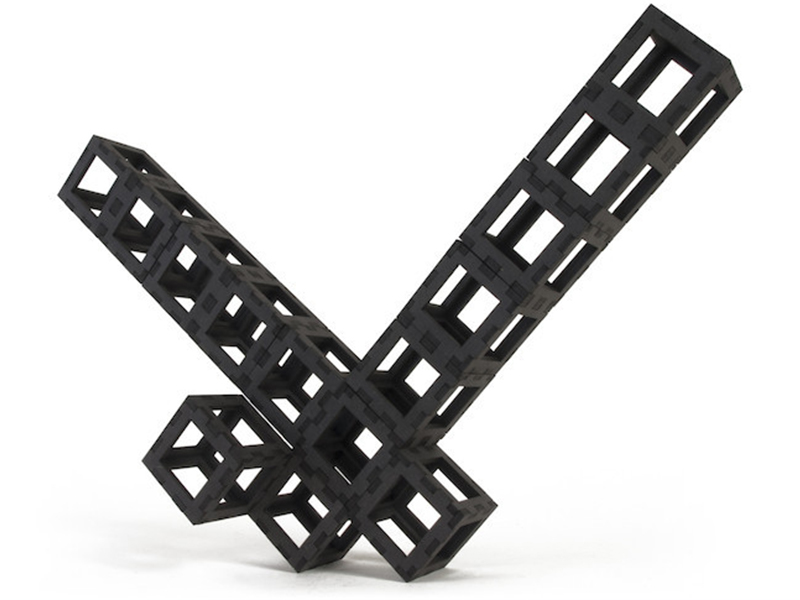
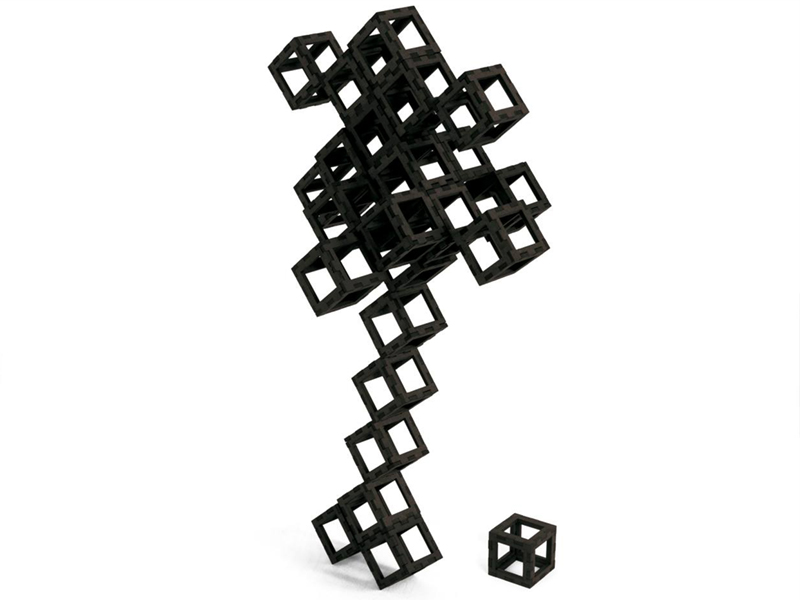
The cube, an orthogonal parallelepipedic prism of eight equal sides, is inextricably linked, from the time of the very first civilizations, to open, inhabitable spaces. For such a simple, sparse and symmetrical shape to achieve any sort of expressiveness there must be some irregularity involved or some relationship with its surroundings. This cube game deals exclusively with the relationship between cubes that are identical to each other, each cube thus making use of a language inherent to itself and to its own properties as contemplated by the human eye. The game puts us in touch with an array of primordial, poetic sensations and feelings: precariousness, instability, rigidity, risk, audaciousness, solidity, levity, surprise, tension, fragility, reason, strength, functionality, rhythm, emptiness, fullness, strangeness, harmony, spontaneity, rigorousness, skill, complexity…. These are just some of the great many elements of the architectural poetics that arise in the final mixture, which is, of course, unquantifiable as well as undescribable; no words could possibly take the place of the lyricism of the final result.
In the words of Swiss writer Robert Walser, “All work well done, even the most trivial, requires poetic inspiration”.
We present this cube game with the idea that it may serve to reveal in players the kinds of reactions that take place when observing and discovering unexpected sensations. These feelings, which often appear in a somewhat blurry form at first, may cause us to reevaluate ous sense of humor, our analytical abilities or our openness to – or rejection of – these novel feelings themselves.
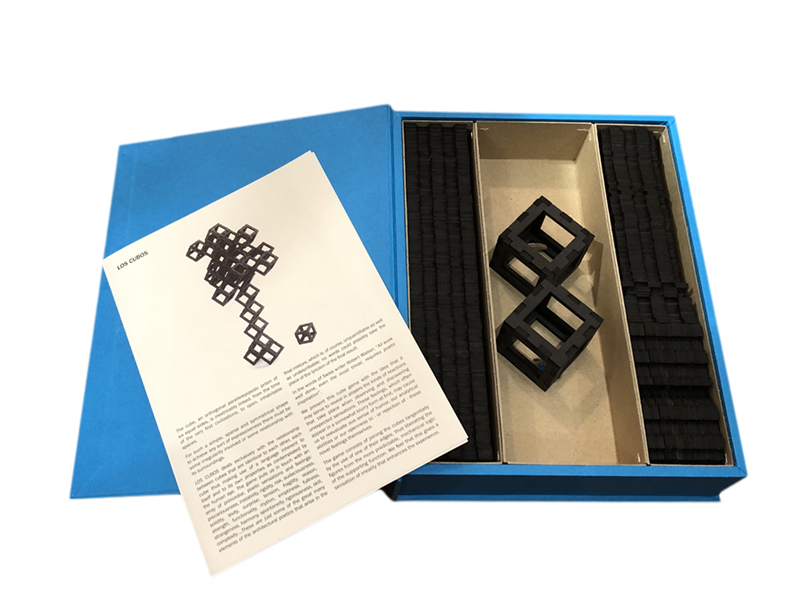
The game consists of joining the cubes tangentially by the use of one of their edges, thus liberating the figures from the more predictable, mechanical logic of the supporting function. We feel that this gives a sensation of irreality that enhances the experience.
Piece of «Pico Pao» workshop with a long artisan history whose history begins in 1979 in Lubián, a small town in Spain hidden in the mountains bordering Portugal. In the neighboring region of Tras os Montes (behind the mountains), the woodpecker is called Pico Pao (wooden peak). The song of this beautiful green bird sounds like the neighing of a horse and the blows of its beak on the trees are heard in the valley mixed with the hammers of the carpenters striking the wood of the roofs. From a workshop in Zamora, the Bermejo brothers have taken their ancestral pastimes to the MOMA in New York and the British Museum in London. In the era of video games and virtual overdose, Pico Pao’s handcrafted pieces amuse half the world.



Reviews
There are no reviews yet.